
The mechanics and history of catastrophe.
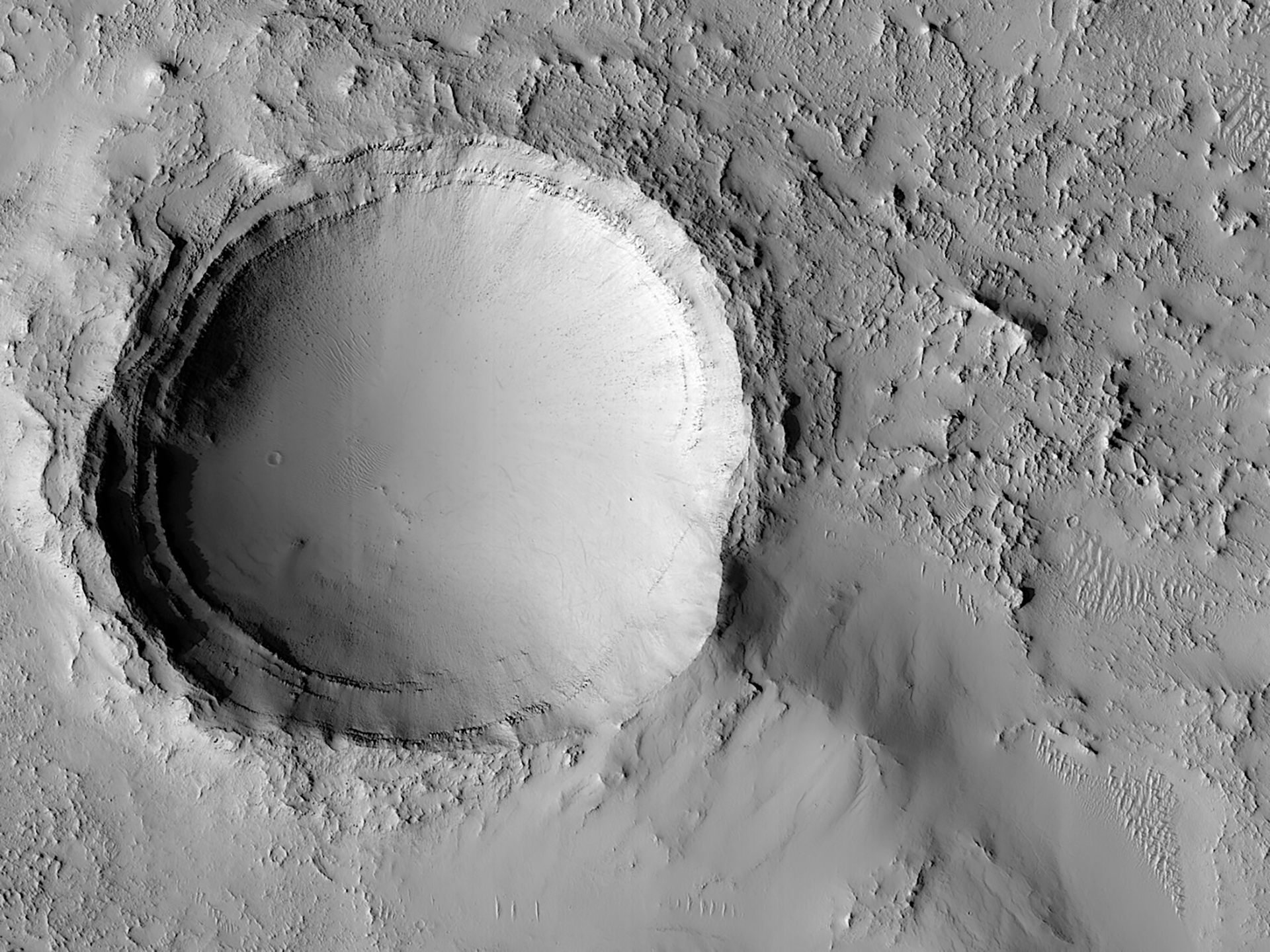
Planetary surfaces provide clues to the evolution of a solar system body. Craters are the result of one of the most important processes to effect planets, asteroids and moons. Hypervelocity[1] meteoroid impact cratering is a fundamental geologic process that affects the evolution of the entire solar system.
Unlike on Earth, most planetary crusts are long-surviving witnesses of impact bombardment[2]. This knowledge helps us understand the evolution of the solar system. The meteorite scars of a planetary body offer clues to the relative surface age and crustal structure of a planet. Furthermore, impact size and frequency of craters also add to understanding a planet’s age. This process is known as crater morphology.
Current projects aim to study planetary impact sites, investigate impact craters on Mars and understand the processes of shock-wave related deformation[3] associated with impact events. Methods used to unravel these processes include:
- Crater counting
- Numerical impact modelling
- Impact experiments
- Accessory mineral dating
- Mineral deformation studies of meteorites and terrestrial rocks
- A broad range of lunar and planetary remote sensing data
Principal leads include Dr Aaron Cavosie, A/Prof Nick Timms, A/Prof Katarina Miljkovic, Prof Fred Jourdan and Prof Gretchen Benedix.
[1] Hypervelocity speeds are more than 4 km per second.
[2] In the early solar system there was an intense period of meteorite and asteroid impacts. This is impact bombardment.
[3] Shock or impact metamorphism is a phrase used to describe heating and deformation during impact events.