The details
SSTC internships are for current Curtin undergraduate students who have both completed at least two semesters of their course prior to commencement of the internship. The internship is intended to support students’ ongoing academic and professional development, so it is preferred that applicants will have remaining semesters of study. The internships will run in-person at Curtin University’s Perth campus over 12 weeks (10 weeks of work plus a 2-week break) between November 2026 and February 2027. The program is a summer research internship, not employment. The award to successful applicants is AUD$7500.
You must meet all of the following eligibility criteria:
- A current Curtin undergraduate student,
- At least two semesters of your degree completed, and
- Not previously held a paid SSTC or Binar Space Program summer internship.
Applications will be assessed on merit. This assessment will be based on:
- Academic performance and prior experience,
- Applicant motivation,
- Benefit to the applicant or program, and
- Applicant suitability for the projects available.
As a part of the program interns are expected to:
- Meet regularly with the project supervisors,
- Apply themselves to the project full-time for 10 weeks,
- Participate in SSTC outreach events during summer, and
- Deliver an end of project presentation and report in addition to the project outputs listed below.
Conditions:
- Interns are required to comply with the terms and conditions of the award.
- Payments are contingent on satisfactory progress.
- Interns may be required to sign a project participation agreement which may include provisions regarding confidential information and intellectual property.
- Interns are required to submit a copy of all project materials and work at the conclusion of the internship.
- While every effort will be made to offer all advertised projects, supervisors may withdraw a project prior to allocation if no suitable applicants are available.
Projects
Mars exploration and tracing signs of past habitability
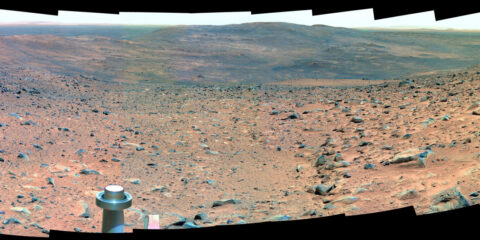
Description: This project is a structural geology mapping project on Mars. Specifically focusing on the Gusev crater and craters within it. The work involves mapping craters using multiple sets of remote sensing and rover data and broadening the search for past water signatures beyond the central peak of the Gusev crater, where the Spirit rover explored.
Outputs: Geological maps and long-form report (or journal publication draft).
Suited to: Third-year Geology, Earth Science or Planetary Science student with prior knowledge of structural mapping using QGIS or ArcGIS, with interest in impact craters and space exploration.
Supervisors: Prof Katarina Miljkovic and Prof Martin Van Kranendonk
Binar Satellite UHF Antenna Design
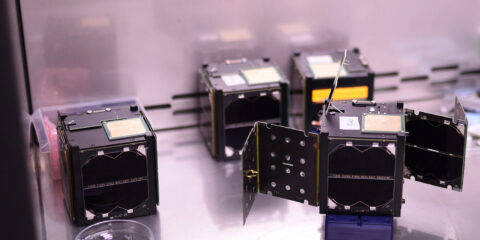
Description: Binar is interested in upgrading it’s UHF antenna system for it’s 1U and proposed larger satellite platforms. This project will involve researching satellite UHF antenna designs and creating or implementing a new antenna design for Binar satellite platforms. Working alongside the Binar engineering team the project will provide an opportunity to work with Binar satellite engineering models to design, build, and test a new antenna system to be flown on Binar spacecraft.
Outputs: A research report into satellite UHF antenna design, and possibly a UHF satellite antenna suitable for flight on future Binar satellites.
Suited to: An electrical and communications or physics degree student. Or a mechatronics and computer science student with an interest in antenna and radio design. Ansys RF design tools will be used.
Supervisors: Dr Fergus Downey, Dr Robert Howie and Dr Martin Towner
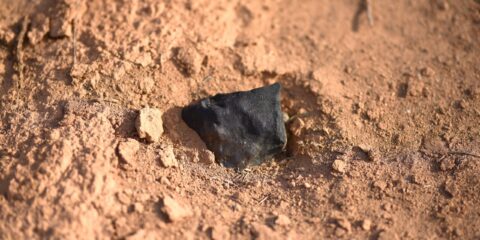
Pathways to Meteorite Identification: Investigating possible WA meteorite finds
Description: In this internship, the student will undergo an investigation of a large collection of rocks recently found and delivered to the DFN team. The intern will work to identify possible meteorite samples within the collection based on external features and characteristics, and will subsequently perform preliminary analyses on the strongest meteorite candidates. Those that are considered meteorites will undergo further testing, including examination of the rock’s interior and possible microscopic analyses.
Outputs: Identification of meteorite samples from a large collection of rocks recently given to the DFN team.
Suited to: A geologist would be most suitable, and anyone with an interest in space rocks and microscopy. Ideally the applicant would have seen meteorites before.
Supervisor: Dr Lucy Forman, Ashley Rogers and Daniel Burgin
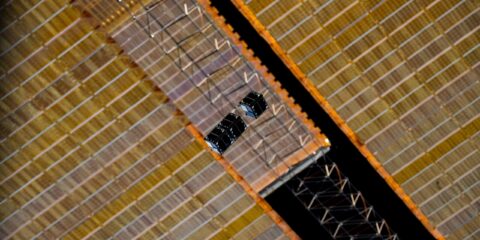
Dielectrically Loaded Helicoidal Antenna Design for Amateur Satellite Ground Stations
Description: Quadrifilar Helix antennas stand out as one of the best for amateur omnidirectional satellite reception; however, they are challenging to accurately build. By 3D printing a forming structure for the antenna, the assembly can be simplified, but the forming structure acts to dielectrically load the antenna and change the resonant frequency. This project seeks to determine a relationship between antenna, structure and density; to allow designers to calculate the effects of the forming structure on their antenna before printing, without needing wasteful trial and error tuning.
Outputs: The primary output will be a relationship between the forming structure design and the velocity factor of the antenna (how loaded the conductors are). This relationship can be used by amateur satellite operators or the SatNOGS community to tune antenna designs without needing to trial-and-error multiple attempts to get the frequency right.
Suited to: Engineering degree (any), min 2nd year for baseline electrical + mechanical design knowledge. Preference towards Mechanical/Electrical/Mechatronics undergrads but not critical (just need a desire to learn!).
Supervisors: Jacob Cook and Dr Fergus Downey
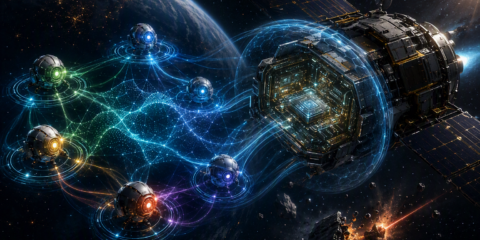
Multi-agent Reinforcement Learning for Distributed Avionics Applications
Description: Spacecraft often use redundancy to achieve reliability in spite of failures, this approach can limit systems to low performance high-reliability and radiation tolerant electronics and increase size, weight and power (SWaP) as well as cost. To improve SWAP requirements and achieve high performance in real time control problems, the Binar Space Program would like to explore a collaborative where numerous off the shelf systems are used together to achieve a common goal without the pitfalls of traditional redundancy or hardening approaches. One of these approaches aims to replace the need for a distributed systems middleware library with a multi-agent reinforcement learning (MARL) model, which would enable decentralised systems to act collaboratively in dynamic physical environments. The objective of this project is to develop a simulated distributed spacecraft avionics control system with multiple nodes working as autonomous agents employing MARL algorithms to deliver a control system that is robust to hardware and software failures without relying on the traditional approaches of hardened electronics or triple modular redundancy with voter circuits.
The project explores how coordinated learning and decision-making in embedded agents can enable fault-tolerant control of physical systems. The project will involve development of the simulation environment, development and training of the MARL algorithms and characterisation of the simulated distributed system.
Outputs: Simulated spacecraft avionics system, MARL algorithms, performance and testing data.
Suited to: This project is suitable for an applicant with some machine learning or embedded programming experience, an interest in reinforcement learning, and some familiarity with control systems and electronics.
Supervisors: Will Blackie and Dr Robert Howie
What I enjoyed most was the balance between independent problem-solving and regular guidance from supervisors. I found it rewarding to work with real data on something that has never been done before.
Liria Siragusa, 2026 Summer Research Intern
This internship offered me the opportunity to collaborate with and learn from some of Western Australia’s leaders in the space industry.
Rayaan Atif, 2025 Summer Research Intern
This internship has been an amazing opportunity for me to learn industry skills and gain so much knowledge around space that I wouldn’t have gained before.
Athena Galbraith, 2024 Summer Research Intern
Applications for 2026/27
Applications close Aug 31.